As the popular social media platform Reddit reads, “A Catch-22 is a paradoxical, circular problem where an individual cannot escape or solve a difficulty because the rules or conditions required to fix it completely deny or contradict each other.”
A Catch-22’ thus becomes circumstances where rules – or decisions made by authorities overseeing a situation - prevent one from escaping that situation.
Originally, ‘Catch 22’ was a satirical 1960s novel written by Joseph Heller that was later made into a popular movie, And, while it was centered around a story which delved into all the contradictions facing military pilots and whether one was sane enough to fly or not fly a bombing mission - and who should or should not do so - perhaps it can also relate to a recent decision by the New Jersey State Interscholastic Athletic Association which prioritizes taking the opportunity of having two straight days at MetLife Stadium in order to have all seven high school playoff group championship games at one site.
Indeed, Colleen Maguire, the NJSIAA’s executive director, recently announced her decision, and in a rather unequivicol manner that left little doubt or wiggle room for the parties involved.
“Play the (Thanksgiving Day) game or don’t play the game, but the point is we’re at MetLife for seven games,” Maguire told NJ.com. “Plan accordingly.”
It is indeed an unusual and potentially touchy situation that Maguire and the NJSIAA find for themselves when it comes to trying to please everyone who may be affected by a yet-to-be-determined field of teams whose respective seaons are still alive and they are playing Turkey Day and/or playoff finals in late November.
Since the Jets will be in Miami and the Giants in Indianapolis on the weekend of Nov. 28-29 the unusual situation has made MetLife Stadium completely available for the Jersey high school playoff group finals for the first time and has inspired Maguire and Co. to schedule the five public and two non-public group finals over the available 2-day period at the big Meadowlands venue.
The 2026 playoff finals situation also means that the NJSIAA’s past practice of utilizing extra days after the Thanksgiving weekend for a couple of weekday games at Rutgers University involving group finals for schools playing on Turkey Day won’t be in the cards.
Maguire’s decision is not fully endorsed by all of those involved with the 10 Thanksgiving rivalries that are still played each Turkey Day in the Garden State, and perhaps there won’t be more than two or three schools ultimately affected by what could wind up meaning having to navigate playing three football games in nine days (A Friday or Saturday group semifinal followed by Thanksgiving Day Thursday game and then a Sunday group final at MetLife).
For those Thanksgiving teams that are still alive in the playoffs, it could definitely be a safety issue for schools such as Camden (in Group 2) or Shabazz (in Group 3) who would have to decide how to deal with the situation.
Camden, a definite team to watch in Group 2, will play Camden Eastside (formerly Camden Wilson) in the 95th Thanksgiving game this year; and Shabazz, which had reached the last two Group 2 finals before being bumped up to Group 3 this year, will take on Brick City neighbor Weequahic in a popular Turkey Day contest referred to as the ‘The Soul Bowl.’
Barringer and East Orange Campus (formerly East Orange High School before the merger with Clifford Scott) have been playing on Thanksgiving since 1897 with a couple of interruptions in the series along the way due to changing conference constraints.
Two of the all-time Thanksgiving traditions remain in the state’s longest-standing matchup: Millville vs. Vineland getting ready for their 151st Turkey Day football game on Nov. 26, and the popular Jersey-Pennsylvania clash of Phillipsburg vs. Easton set for their 120th meeting this November.
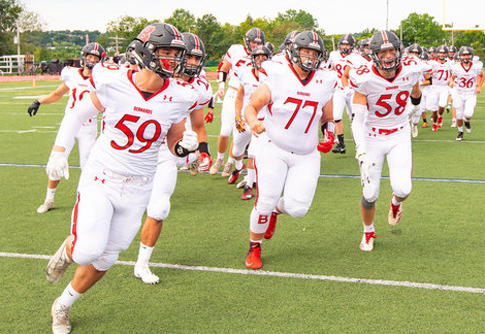
The small crowds for playoff group championship games at either MetLife or Rutgers is an undeniable fact; however, we’re told that running out of the tunnel at MetLife Stadium is still an absolute thrill for today’s players who can be excused for having no idea what Thanksgiving football traditions mean to certain schools and the remaining ‘old-timers’ in Jersey high school football who maintain great memories of those rivalries.
Gone are longtime Thanksgiving Day matchups such as Plainfield vs. Westfield and Roselle-Roselle Park in Union County or Paterson Eastside vs. Paterson Kennedy in Passaic County.
Many modern-day playoff enthusiasts might say, 'The heck with Thanksgiving football,' but there is also no denying the fact that the games still can hold a special place in the hearts and minds of those who relish the rich history of New Jersey high school football.
Topical Turkey Day Games Include 1973 Montclair At Bloomfield
One of the great, former Thanksgiving rivalries was Bloomfield and Montclair, a holiday series which ended for good in 2017 when the Mounties won 49-13 on Thanksgiving Eve.
The two teams still meet during the regular season, but the Thanksgiving meeting was having waning interest in its last few seasons when the games at Foley Field were played on the Wednesday evening before Turkey Day and frequently before small crowds.
However, just three years ago was the 50th anniversary of the memorable 1973 Bengals-Mounties Thanksgiving clash, which drew a huge crowd to Foley Field that day and created a great deal of controversy about the catch ruled a winning grab by Bloomfield end Jack Clauburg.
Former Mountie star Dale Berra and ex-Bengals standout TK Tripucka, who both played in that game, came back to the new Foley Field in 2023 to reminisce about that much-talked-about 1973 neighborhood clash.
There had been no telecast of the 1973 Montclair-Bloomfield Thanksgiving Day football game even though ABC TV’s Chris Schenkel was one of the interested observers in a crowd of approximately 15,000 fans who packed Foley Field that morning in a bowl game-like stadium atmosphere.
Schenkel had previously done play-by-play on the DuMont Television Network for the 1957 Montclair-Bloomfield game won by the Robert Haines-led Mounties, 21-3, in what at the time was the only high school football game shot in color for TV, and the veteran broadcaster knew first-hand just how intense the rivalry was even though Montclair had dominated the Bengals for the majority of the holiday gridiron series.
Whatever his reasons for being there again 16 years later to see Montclair-Bloomfield in a 1973 Turkey Day battle between two of the best teams in the state that fall, the experience apparently made a lasting impression on the veteran college football broadcaster who obviously appreciated great high school football.
“I was playing for the University of Maryland in the 1975 Gator Bowl against Florida and Chris Schenkel told me that the 1973 Montclair-Bloomfield Thanksgiving game was the best high school football game that he had ever seen,” recalled John Stanford, Bloomfield’s all-state end. “One thing for sure, that game in ’73 was more than just a football game; it was an ‘event!’”
Unfortunately, as it turned out, there was no TV coverage of the 1973 game, and that proved important in the aftermath of what occurred because the actual film stock of now archaic 8-milimeter versions from the contest have either dissolved after frequent reviews of the controversial final minute - which happened with Montclair’s game film - or have simply disappeared, as is apparently the case with the Bloomfield film.
Now 50 years later, the 1973 Montclair-Bloomfield game still took on a life of its own since, while the Bloomfield players believe they were the better team that warm, sunny late November morning, there remain those from Montclair who firmly believe that the game was stolen from them because of what they insist was a blown call by the referee on a critical, last-minute pass into the end zone that was ruled a Bengals go-ahead TD reception accounting for their 15-12 comeback victory.
It is a play which has plenty of colorful thoughts and controversy still surrounding it, even if there is no video left showing what actually occurred on the 2nd-and-goal pass into the end zone from the Mounties’ 6-yard line with 58 seconds remaining.
It was a short curl pattern into the middle of the end zone delivered by quarterback Mike Casale to tight end Jack Clauberg that was ruled a completion for a touchdown by the game’s head referee, Herman Pizzi, but the Mountie faithful to this day insist that the ball hit the ground before the Bengal receiver wound up with the ball on his lap.
“I clearly remember there was a lot of traffic there in the end zone, and I wasn’t exactly wide open on the play,” recalled Clauberg. “Mike was a very accurate thrower, but, as he let the ball go, he was hit on the play and the ball actually went backwards, and I saw it heading toward (Montclair linebacker) Oscar Collins.
“I was more worried about an interception at that point, and just as Oscar appeared to hit the ball down someone hit me from behind. I went down on the field, rolled over and the ball had landed on my lap.”
“I saw the referee looking down at me, I showed him the ball and he signaled a touchdown.
“I never saw the ball hit the ground.”
Other Mountie defenders were close by on the quick-developing and ultimately controversial play.
“I was right next to Oscar, maybe two feet from him, and saw him bat the ball down,” said Mounties cornerback Dale Berra. “I remember thinking at the time, ‘Why didn’t Oscar intercept the pass,’ but he was a great player and he just decided to do what he did on the play.
“I saw Clauberg falling down, the ball hitting the ground, and then it wound up on top of him.”
The rapid nature of all the important elements leading to confusion and controversy still linger in certain hearts and minds that care very much about what occurred a half century ago.
“It all happened in a nanosecond, said Bloomfield’s TK Tripucka, a starting lineman and placekicker, whose first quarter field goal would prove to provide the winning margin in the game. “Jack had his back to the official and the ball apparently had ricocheted up into his chest.”
For Bloomfield’s erudite senior signal caller, it had been a rare opportunity to call his own play on the 2nd-and-goal situation.
“Coach (Sam Cavallaro) would not usually let me call a play, but he let me do it there on second down,” said Cassle, who would go on to play at the University of Connecticut and later become a longtime New Jersey state superior court judge. “I knew that they were doing a good job of covering John Stanford even though he had caught a touchdown earlier in the game, so I figured the tight end (Clauberg) might be a good option there.
“Although I was hit hard on the play apparently the ball hit the ground on its point and bounced up like a basketball while Jack was going down.”
If one nearby official’s signal of an incomplete pass had been accepted as the right call by the referee Pizzi then the Bengals would still have had at least two more downs to try and reach the endzone; but there was also a penalty flag thrown on the play.
“What people tend to forget was that there was a pass interference called on the guy covering me on that play,” said Stanford. “So, regardless of whether it was a catch or not, we would have had a first-and-goal.”
Bloomfield had begun its last drive from deep in its own territory.
“I know that to be the case because I remember we began our first huddle of that winning drive in our own endzone,” recalled Clauberg. “We knew that it would be our last possession and we were determined to go the length of the field there.”
There was a key fourth down run by back Wayne Ripley where he managed to reach out and earn the first down, and the Bengals continued on the move downfield eventually entering the red zone and knocking on the door to score as time was winding down.
The climactic pass to Clauberg in the end zone remains the one hot topic that won’t relent, even now more than a half century later, still revives spirited discussions of a memorable Thanksgiving Day football game.